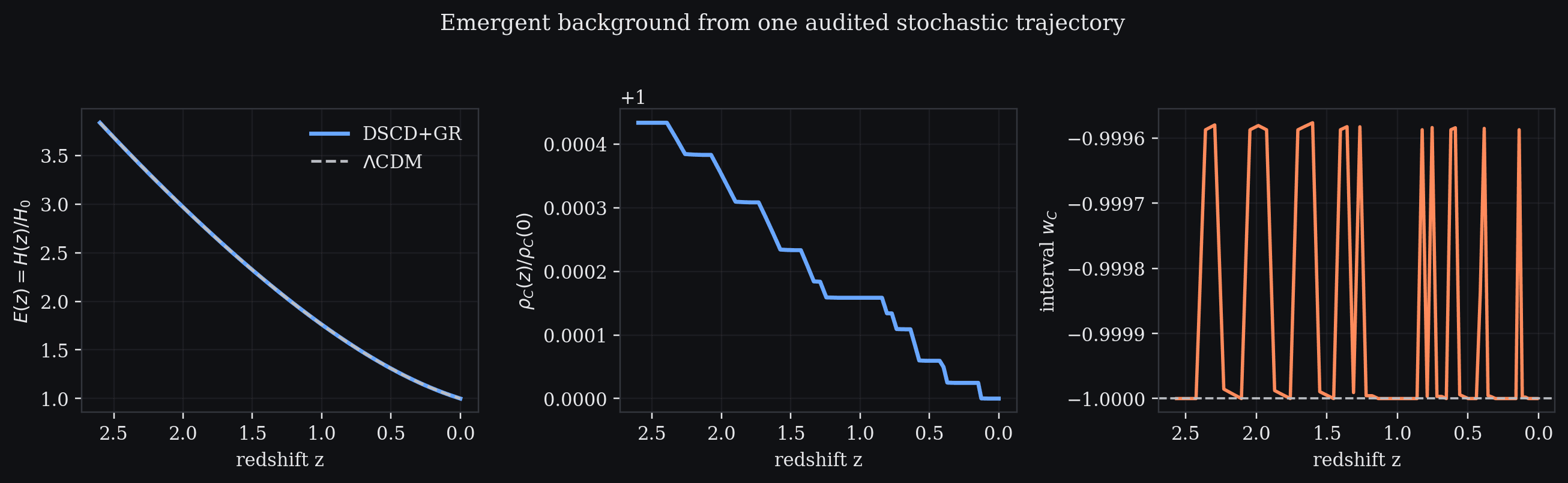
SystemA coupled stochastic DSCD+GR system evolves asymmetric activity, beat phase, structural memory, regimes, transport, free-capacity density, pressure, and FLRW expansion together. No CAS_LOG, CAS_POLY, CPL, or constant-w function defines the DSCD trajectory.
Small validationsV1–V5 verify hand-calculated funded accounting, stochastic event hazards, conservative transport, minimal GR closure, and synthetic distance recovery before any real DESI values are used.
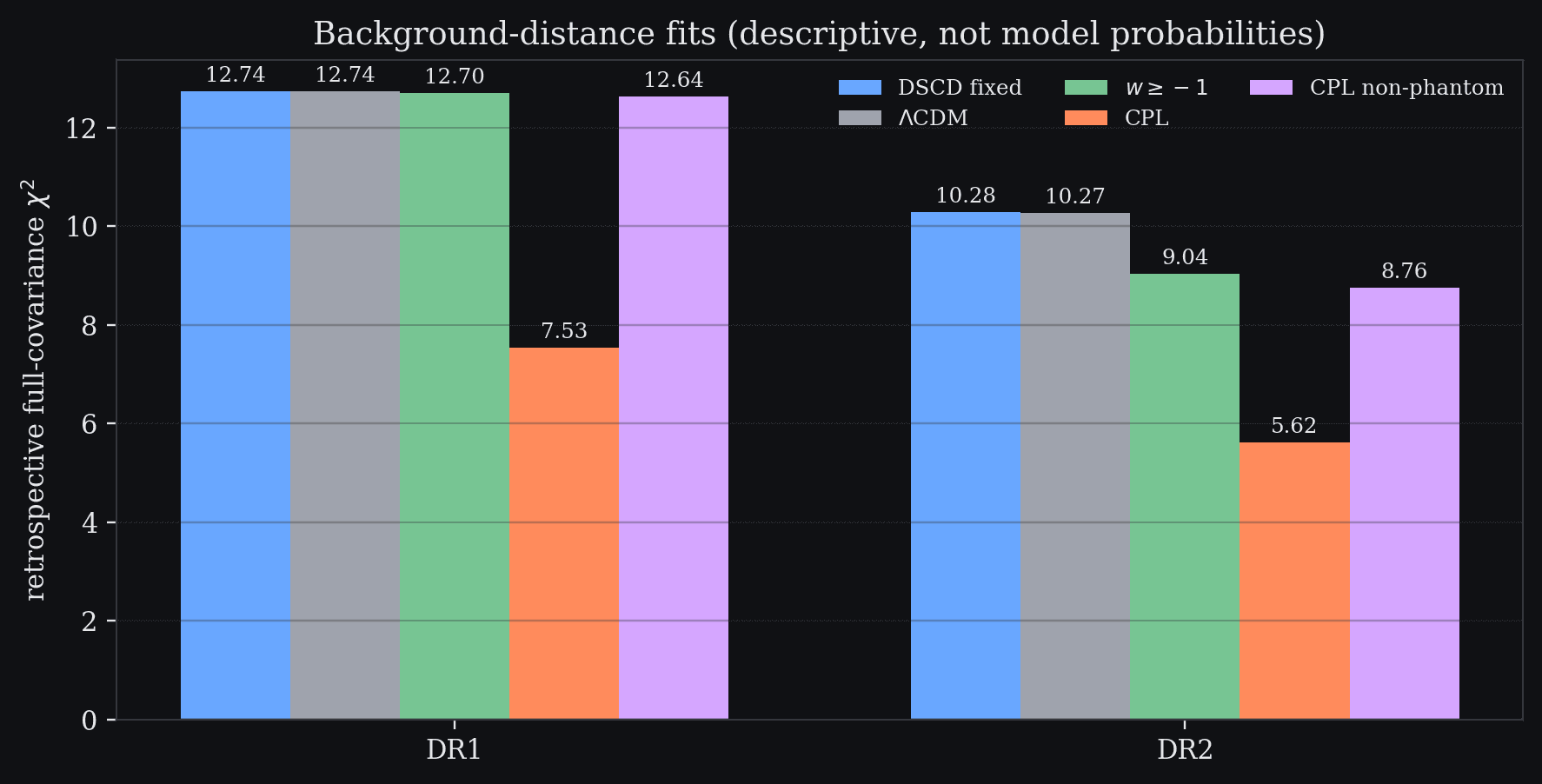
Retrospective resultsWith all DSCD dynamics frozen and only θ = H₀r_d/c and Ω_m fitted, χ² = 12.736 on DR1 and 10.280 on DR2. The retrospective DR1 high-redshift conditional score is 3.466, versus 3.492 for ΛCDM.
Version-1 resultThe depletion combination has condition number 1.06×10⁷ and is not identifiable. Zero-beat, no-memory, no-regime, no-transport, and symmetric-depletion ablations are indistinguishable at current precision. The v1 audit returns NO_FORECAST for any single frozen configuration.
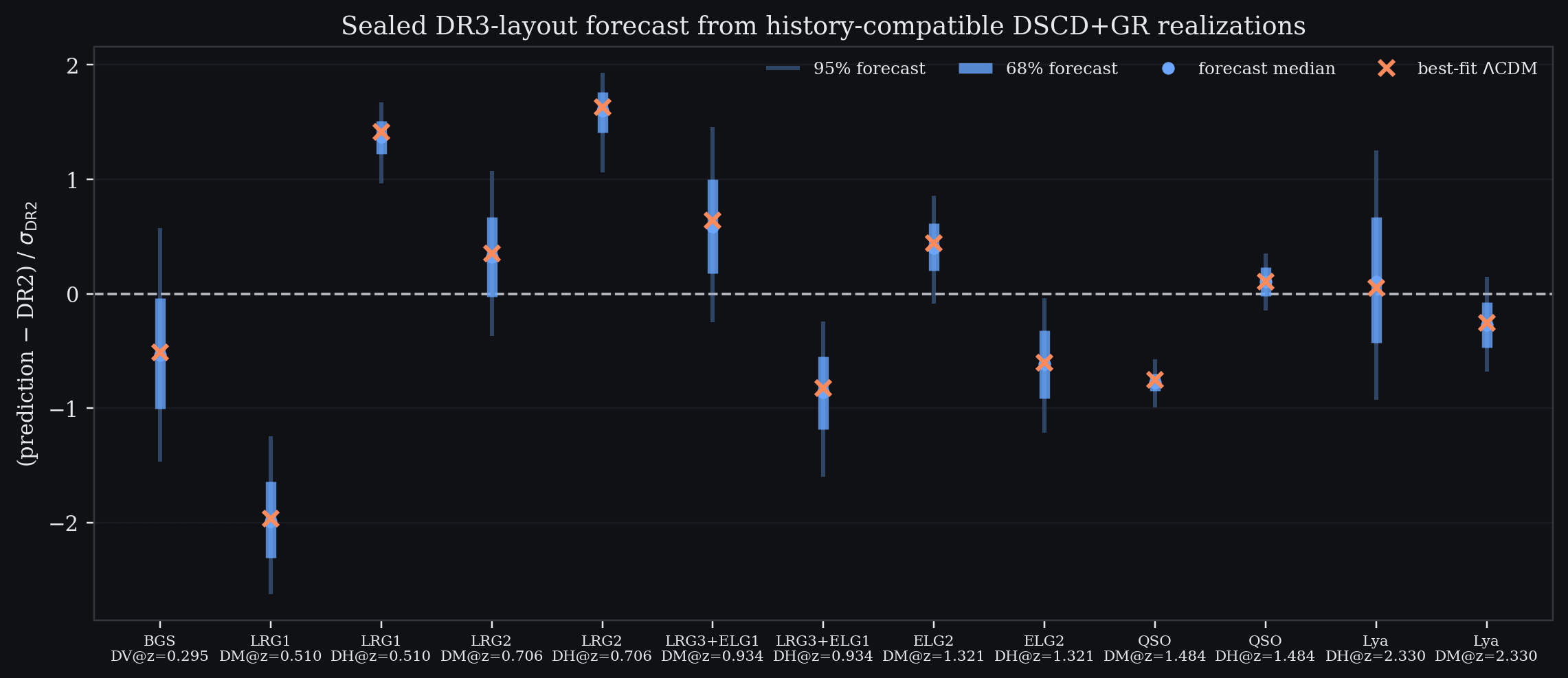
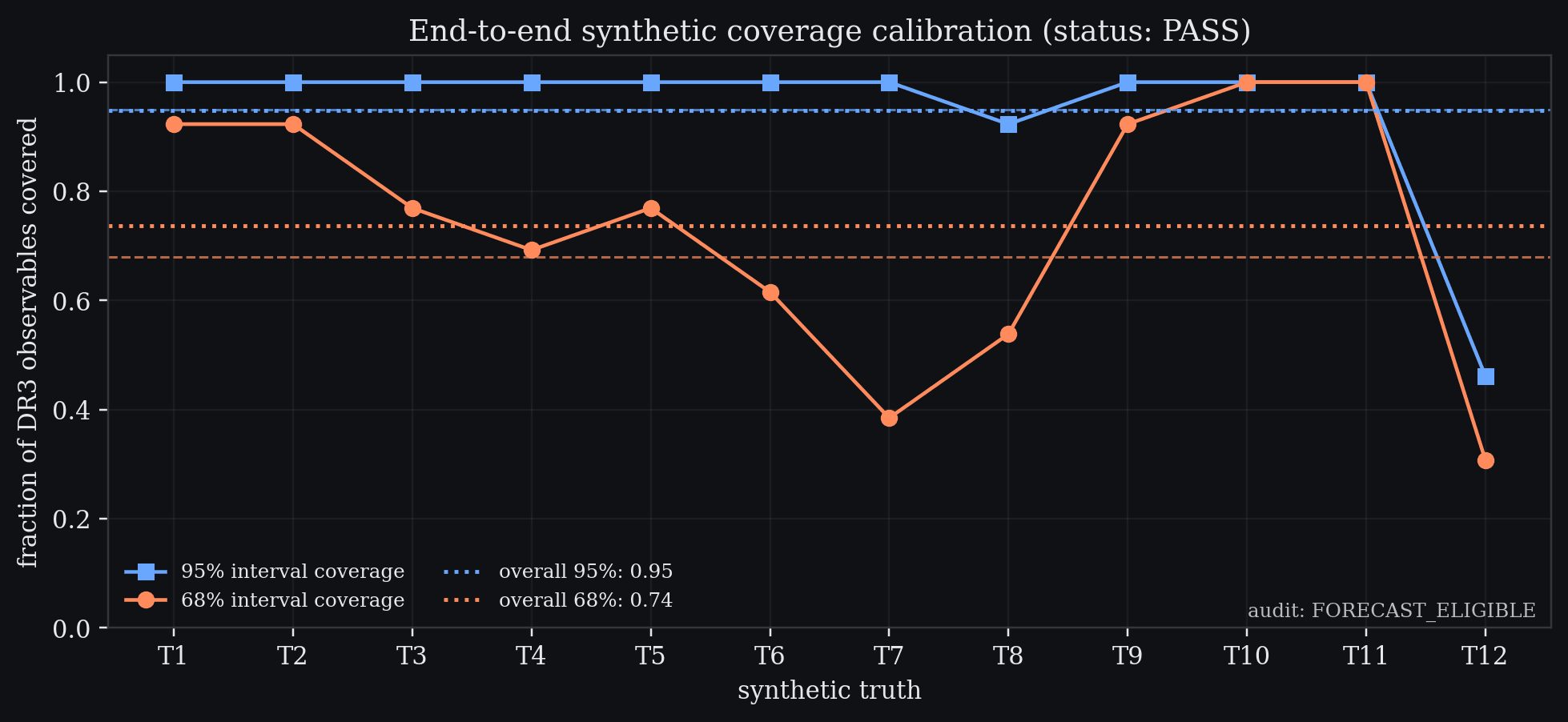
Version-2 resultTreating the present DSCD state as latent, 2048 Sobol-drawn realizations weighted by the joint DR1+DR2 likelihood converge predictively: joint effective sample size 205, medians stable under sample halving, disjoint seeds, and DR2-only conditioning, with end-to-end synthetic coverage of 94.9% (95% level) and 73.7% (68% level). The audit returns FORECAST_ELIGIBLE and a DR3 forecast is sealed.
The conditional trajectory relation wC ≥ −1 follows only when the coupled realization has positive density and non-negative depletion. It is a background corollary of the declared GR closure, not a standalone theorem transferred from Part I, and it does not prove the null energy condition or microscopic stability.
Full source hashes, validation artifacts, retrospective residuals, ablations, and audit gates are available in the repository.